Tech Stack
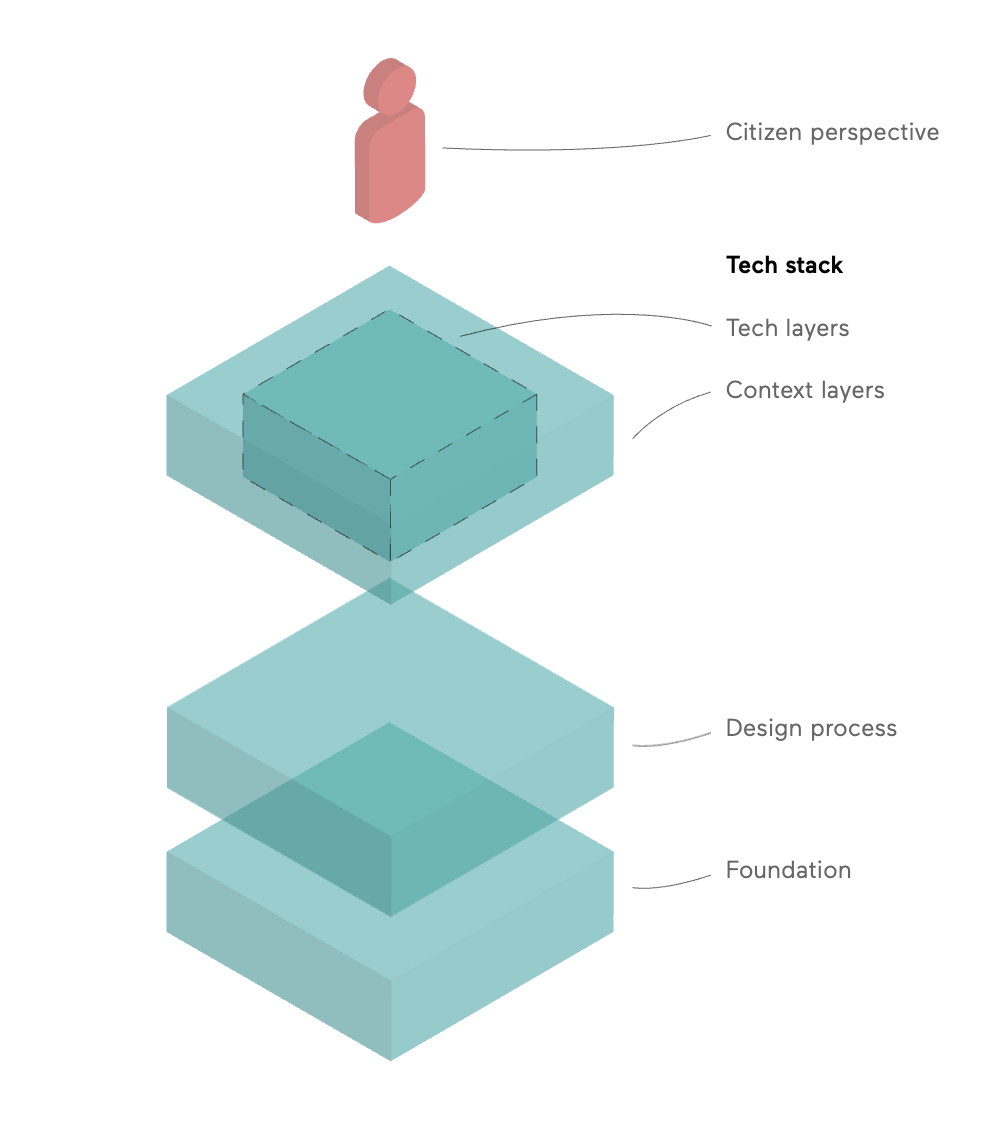
A tech stack has layers — infrastructure, OS, applications — and those layers often have genuinely different organisations and teams behind them, each with its own way of working and its own stakeholders. What cuts across that separation is context: concerns like security that apply at every layer regardless of who's building it, forcing a shared awareness that layer-by-layer ownership wouldn't produce on its own.
Layers is the vertical stack itself: from the infrastructure at the bottom up through the operating system to the applications that citizens actually use. Each layer depends on the one below it, and decisions made lower in the stack constrain what is possible above.
Context covers the cross-cutting concerns that apply at every layer: which services are exposed, how they are secured, what protocols and standards they follow, and how data and algorithms behave. These aren't separate components — they are properties that each layer needs to uphold.
We also simplify Public Stack's own layering: it treats infrastructure, equipment, and firmware as separate layers, each with its own stakeholders and dynamics. On a managed cloud, that distinction mostly disappears — a provisioned instance already abstracts all three into one concern, so keeping them apart adds layers without adding a separate decision to make. What stays meaningfully distinct is the OS running on that instance, and the applications running on top of it.