Citizen Perspective
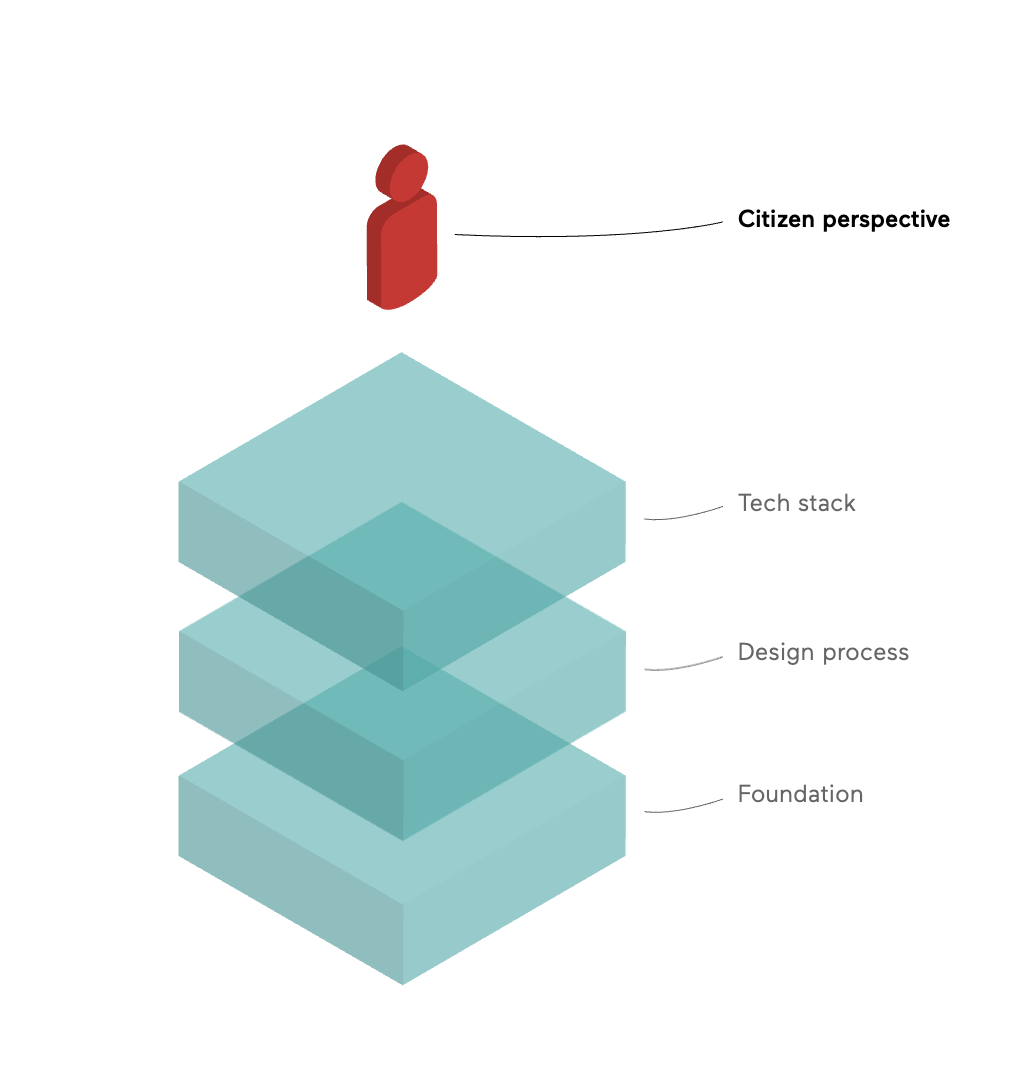
The Public Stack frames the user not as a consumer or a subject, but as a citizen in a democratic society. Every layer of the stack shapes this relationship — and determines whose interests the technology actually serves. Some of that is visible, like the interfaces of websites and the apps on our phones. But much of it isn't — the influence media has on our thoughts, how algorithms determine what we view, and how our data is used for huge profits.
A self-organising citizen
We take that framing further. A citizen is not just a recipient of services, or a puppet to be mined for design requirements, but an active participant in how those services are run. Self-hosting opens the infrastructure up to self-organisation: anyone with the interest and capability can deploy something, try something, or change something — without waiting for permission from a vendor, a platform, or a central authority. The infrastructure becomes a shared resource that people can act on, not just use.
This is an anarchistic idea in the original sense: power organised from the bottom up, without a central controller deciding what's allowed. It doesn't mean no structure — it means structure that emerges from the people using it, not imposed on them from outside. This goes beyond co-creation — co-creation still puts someone else in charge of the agenda. Here, the people using the infrastructure are the ones shaping it, with direct access and real authority.
That's where this view differs from the Public Stack's own: not a citizen sitting at the top of the stack, but one living inside it — shaping it and being shaped by it at the same time, never just a user of a finished thing, and never just a product of what's been built. It brings back the agency to actually change things, where commercial technology — and even a public stack — can feel almost impossible to affect. We design for experimentation, and for the unexpected. We design to bring back hope.
Three roles
That way of organising infrastructure doesn't produce a single type of citizen. It produces at least three:
Resident — most people encounter the stack as residents: living in the tools, benefiting from the infrastructure, and expecting it to work in ways that serve their interests rather than extract from them.
Maker — some go further and build things: they experiment, and from them emerges the unexpected. A maker doesn't need to ask permission — the shared foundation is already there. What they try, and what sticks, strengthens the whole.
Steward — someone has to keep things running. The steward takes responsibility not because they were assigned to, but because they chose to. It's a role that can be shared and handed off as more people build the skills and confidence to take it on.
We model these roles, but there are many more roles and identities possible. We design for those to emerge, but we feel that we've got to describe these three to allow those to flourish.